 Linearfinance
 offered synthetic and perpetual trading before announcing its 2025 shutdown
Linearfinance was a multi-chain crypto platform for synthetic assets, perpetual contracts, and peer-to-peer trading before its announced 2025 shutdown. Its ecosystem included Builder, the Synthetic Exchange, a bridge, a Marketplace, and PerpDEX. The operations team scheduled final closure for 2 April 2025 at 12:00 UTC. The closure plan retained a burn-and-unstake portal for debt repayment and collateral withdrawal. That planned exception did not establish continuing access to the wider trading suite.
Outstanding Builder debt governed collateral withdrawal
Builder let users stake collateral and mint Linear USD (LUSD), creating debt. LINA was the protocol's native token. The original whitepaper assigned it collateral, reward, and governance roles, including votes on asset listings and collateral ratios. The wind-down instructions required debt repayment before withdrawing collateral backing those positions. The amount eligible for withdrawal depended on the debt position. A staking balance and a freely held token balance therefore had different exit conditions.
Repayment assets and staked collateral
Burning LUSD reduced Builder debt
Linear USD (LUSD) was the repayment asset. The original debt-pool design linked participants' liabilities to the system's synthetic-asset portfolio. Holding LUSD alone did not repay debt. Burning it reduced the outstanding amount.
Unstaking released the collateral
The wind-down covered LINA and other collateral tokens. Builder users had to repay outstanding debt before unstaking them.
The original synthetic pathway connected collateral and exposure
Synthetic assets, called Liquids, represented market exposure within the protocol. Linear Whitepaper v2.0 targeted cryptocurrencies, commodities, market indices, and thematic exposures. Its original design linked LINA collateral, LUSD, and those assets in a round trip. In that design, the debt pool was the counterparty and oracle feeds supplied underlying asset prices.
| Stage in the original design | Component relationship | Required balance or condition |
|---|---|---|
| Acquiring LINA | Supplied the collateral token | A partner fiat gateway, centralized exchange, or decentralized exchange |
| Staking and minting | Builder created LUSD | LINA and the required collateral ratio |
| Trading synthetic exposure | The Synthetic Exchange used LUSD | LUSD and an operating exchange |
| Claiming eligible rewards | Claims distributed fee shares and staking rewards | Accrued rewards and a qualifying collateral ratio; inflation rewards were locked for one year and automatically staked |
| Returning exposure to LUSD | Conversion supplied the repayment asset | Synthetic assets and available conversion |
| Burning LUSD | Debt repayment unlocked staked LINA | Enough LUSD to clear the position's debt |
| This historical design depended on functioning applications; the later closure restricted access to its components. | ||
Conversion changed the asset held. Burning enough LUSD cleared debt and enabled collateral release. Selling LUSD externally served a different purpose and did not perform that burn.
The Synthetic Exchange restricted final conversions to LUSD
The Synthetic Exchange entered its final exit period with terminal prices already applied to its remaining synthetic assets. Only conversions into LUSD remained supported on the Synthetic Exchange during the final exit period. This restriction changed the exchange's purpose from moving between synthetic exposures to winding them down.
LUSD was the output of that restricted conversion. The closure instructions identified PancakeSwap as the venue for selling it externally. The operations team also warned liquidity would become increasingly limited during the exit period. The conversion instruction therefore did not establish an unlimited external market or a fixed sale value.
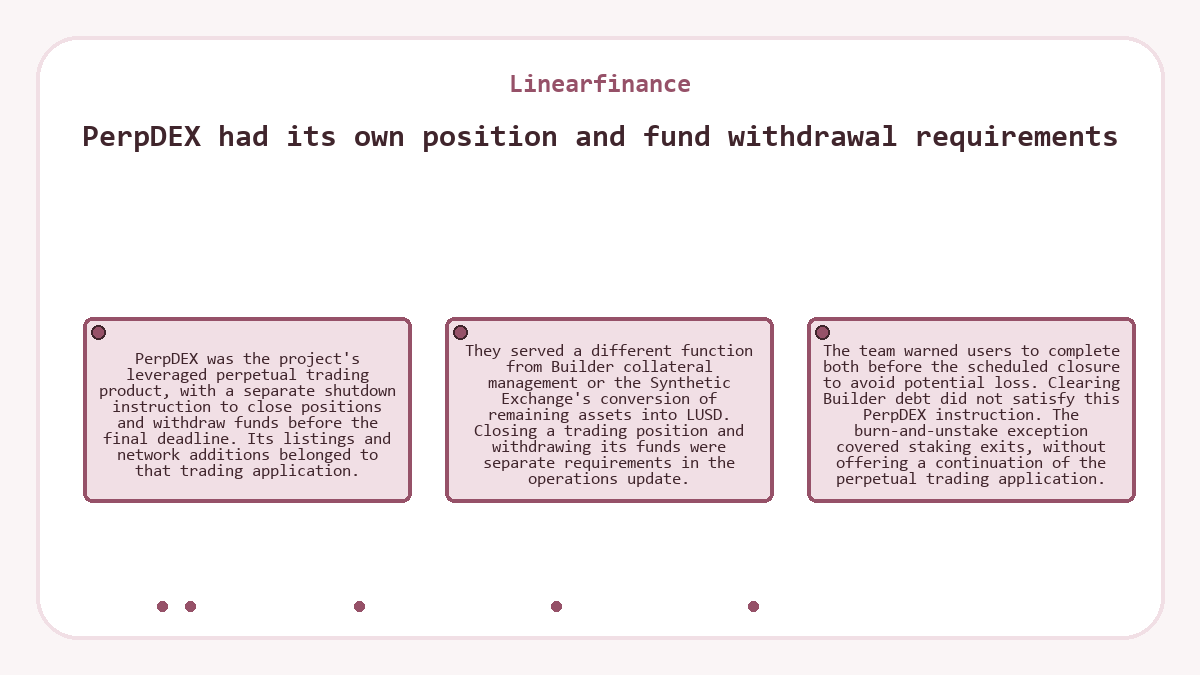
PerpDEX had its own position and fund withdrawal requirements
PerpDEX was the project's leveraged perpetual trading product, with a separate shutdown instruction to close positions and withdraw funds before the final deadline. Its listings and network additions belonged to that trading application. They served a different function from Builder collateral management or the Synthetic Exchange's conversion of remaining assets into LUSD.
Closing a trading position and withdrawing its funds were separate requirements in the operations update. The team warned users to complete both before the scheduled closure to avoid potential loss. Clearing Builder debt did not satisfy this PerpDEX instruction. The burn-and-unstake exception covered staking exits, without offering a continuation of the perpetual trading application.
The bridge closure plan covered Ethereum and BNB Smart Chain
The closure plan scheduled permanent closure of the project's LINA and LUSD bridges between Ethereum and BNB Smart Chain at the shutdown deadline. It covered transfers in both directions. That restriction applied to these Linearfinance bridges, without describing a shutdown of either underlying blockchain. A token's network location consequently mattered to the bridge exit window. The retained burn-and-unstake portal offered no replacement cross-chain route in the closure plan.
Marketplace and Liquidator stopped before the main cutoff
The Marketplace was designed for peer-to-peer trading of tokens and NFT Keys representing locked or vesting token allocations. By the operations update, the team had closed the Marketplace and switched off the Liquidator. The update described no active Marketplace listings apart from those previously managed by the team. These components stopped before the suite's scheduled final closure. Their earlier shutdown meant the common deadline did not promise access to every product until that moment. The Liquidator's inactive status also did not remove the debt-repayment condition attached to Builder collateral.
A PerpDEX development plan gave way to the full wind-down
Before the full closure decision, the project announced a PerpDEX focus and plans for AI-assisted trading tools, alongside plans to retire Builder and the Synthetic Exchange. The proposed tools covered live market insights, automated execution, and trading analytics. The team also described a new staking portal as under development.
The later decision to cease operations changed that direction. PerpDEX joined the shutdown plan, and the operations team instructed users to exit existing positions. The earlier announcement described a staking portal under development; the closure update specified a burn-and-unstake portal for exits. A development roadmap did not establish delivery of its proposed tools.
Funding pressures brought the operating model to an end
The project cited an unsustainable funding model as its reason for ceasing operations. Owner contributions and token liquidations had financed its work. The closure decision identified these resources as insufficient to sustain operations. The team described a brief profitable period around its initial 2019/20 launch, followed by increasing financial difficulties. It identified Binance's LINA delisting decision as an event which accelerated those existing problems.
Financial difficulties preceded the delisting decision. The project then lost more of its remaining operating runway and decided to wind down. The closure announcement described the principal stakeholders as having already exited their positions. Their exits did not mean every user's staking, synthetic, or perpetual position had closed automatically.
The burn-and-unstake exception preserved a limited exit purpose
The closure plan retained the burn-and-unstake portal as an exception to the main dApp shutdown. Its intended functions addressed debt repayment and staking withdrawal. The exception did not extend Synthetic Exchange trading, bridging, or PerpDEX operations beyond their scheduled closure.
All remaining locked and vesting rewards moved into the staked balance during the exit period. Their original schedule spread vesting over the following 12 months. Withdrawal still depended on the debt position, so moving those rewards did not remove the collateral-release condition.
The scheduled closure time was 2 April 2025 at 12:00 UTC. The operations team placed the wider dApp suite, the bridges, and PerpDEX within that shutdown. Marketplace and Liquidator had already stopped earlier.
The portal exception described an intended continuation after that deadline. It did not establish the portal's present accessibility.
A remaining Builder balance therefore raises a specific question: whether outstanding debt still prevents collateral withdrawal. Unstaking any remaining collateral would require a functioning exit interface and satisfaction of the position's debt conditions.
Common questions about Linearfinance
When was Telegram and Discord chat support due to end?
The closure plan scheduled Telegram and Discord chat to end at the 2 April 2025 shutdown. The operations update offered support until that date, primarily through Telegram and secondarily through Discord. It did not promise continuing community support after the cutoff.
Had PerpDEX supported Berachain before the shutdown?
PerpDEX announced Berachain trading support before the project's closure decision. That addition concerned the perpetual trading application within the project's multi-chain ecosystem. The later operations update included PerpDEX in the shutdown, so the earlier network addition did not establish continuing access to an active trading service.
Could a LINA listing elsewhere keep the Linearfinance applications running?
A LINA trading listing on another exchange did not keep the Linearfinance applications operating. External markets handled token trading, while the project's operating team set the dApp shutdown. The presence of a LINA market answered a different question from whether Builder or PerpDEX remained available.
How long was the burn-and-unstake portal meant to stay available?
The closure plan retained the portal after the main shutdown without setting a final access date. That described an intended continuation of debt-clearing and unstaking functions. It did not guarantee permanent maintenance or demonstrate the portal remains accessible.
Was the March 2025 trading competition scheduled beyond the closure date?
The advertised March 2025 PerpDEX competition preceded the scheduled 2 April 2025 shutdown. Its advertised trading period ran from 20 to 27 March 2025. Those dates described a limited event before closure and did not establish an ongoing competition or a continuing rewards program.
· updated