 Linearfinance
 offered token sales and NFT Key transfers through its 2024 Marketplace
Linearfinance used its 2024 Marketplace for peer-to-peer token sales and transfers of vesting allocations. A token sale transferred the listed token asset. An NFT Key sale transferred ownership of a locked or vesting allocation, with token release governed by its terms. Both formats used listings, seller-set prices, and escrow; buyer restrictions and recipient settings served different purposes. The allocation's vesting conditions remained important because its ownership could change before the underlying tokens became available for the new owner. The project later wound down, and its 2025 operations update described the Marketplace as already closed.
Listings and escrow connected both sale formats
The Linear Marketplace was a peer-to-peer listing service with escrow for token assets and NFT Keys. Sellers could create listings, choose prices, and specify whitelisted buyers. The browse area displayed token and NFT orders.
The Synthetic Exchange used the protocol's debt pool for synthetic exposure. Marketplace sellers set prices for listed assets.
What changed hands in token and NFT Key sales?
A token sale transferred the token asset, while an NFT Key sale transferred ownership of an allocation containing locked or vesting tokens. That difference affected what the buyer held after completion and when the underlying tokens became available.
Token holdings
A token listing offered the token itself as the sale object. The seller set its price through the Marketplace. This format concerned the listed token asset, without requiring an NFT Key to represent ownership of a separate vesting allocation.
NFT Keys
NFT stood for non-fungible token. Within this Marketplace, an NFT Key represented tokens held in a vesting contract.
Ownership of the allocation
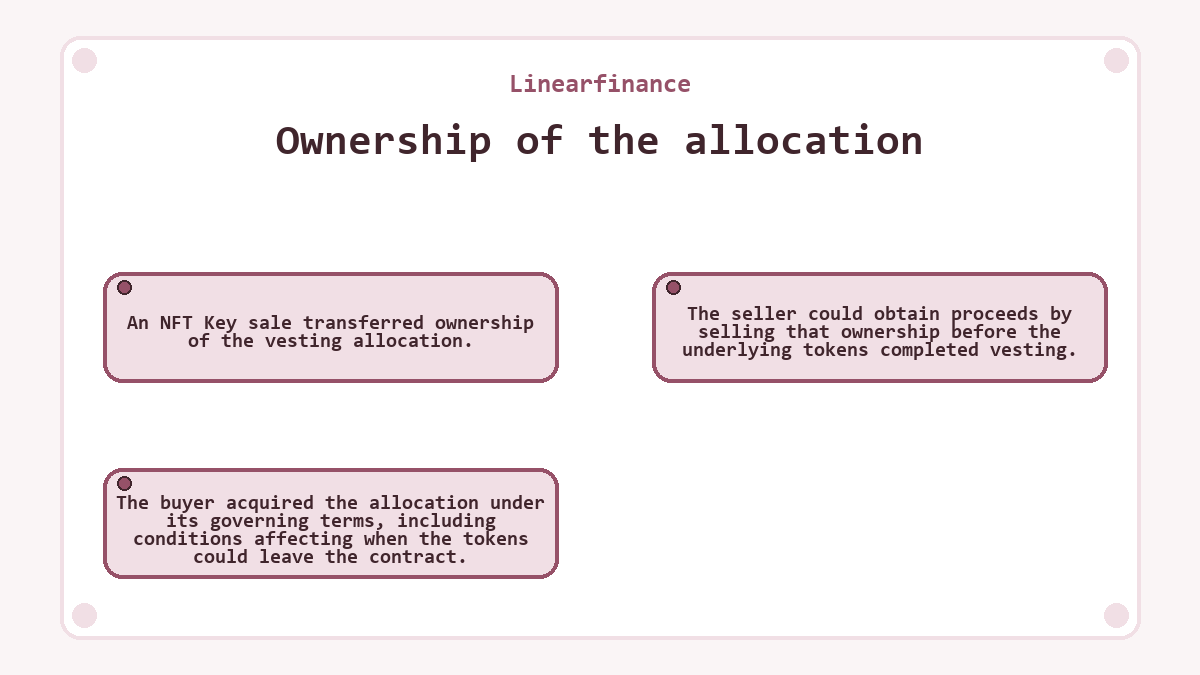
An NFT Key sale transferred ownership of the vesting allocation. The seller could obtain proceeds by selling that ownership before the underlying tokens completed vesting. The buyer acquired the allocation under its governing terms, including conditions affecting when the tokens could leave the contract.
Release of the underlying tokens
Vesting controlled when the underlying tokens became available. Transferring the key concerned ownership; token release still followed the allocation's conditions. An NFT holding could therefore coexist with a still-locked token allocation. The timing question concerned the particular contract's release terms, rather than the date someone bought its key.
Could a seller reserve an offer for particular buyers?
Sellers could specify whitelisted buyers, and the Marketplace showed personalized offers to addresses on those lists. This permission concerned the buyer address before purchase. The interface also had a browse area for token and NFT orders, making general browsing and personalized access distinct functions. The restriction concerned access to the sale, separate from the vesting conditions governing an NFT Key's allocation.
Recipient addresses and buyer whitelists served different purposes
The escrow feature let users designate a specific recipient wallet address for a Marketplace transaction. The launch announcement did not specify whether that recipient received purchased assets or sale proceeds. Buyer whitelisting concerned access to a seller's personalized offer.
Choosing a recipient address did not, by itself, make a transaction anonymous.
Crowdfill widened an offering's buyer reach
Crowdfill let sellers make an offering available to multiple buyers simultaneously. It concerned the audience for an offer, while the token-versus-NFT Key distinction concerned the asset offered. That broader reach gave early-stage or illiquid assets another possible trading outlet. Crowdfill's multiple-buyer audience did not guarantee demand, an executed price, or a completed sale.
Holdings and order history described different parts of a sale
My Assets kept separate token and NFT tabs. An NFT Key belonged among NFT holdings even though it represented a token allocation. That separation reflected the sale object in the inventory: owning a key and holding its underlying tokens were different wallet states.
My Orders tracked active listings and transaction history, covering sale activity beyond the holdings view. An active listing described an offer; transaction history concerned past trading activity.
Search and filtering covered name, collection, and price. Users could inspect orders in card, table, or list layouts.
A completed NFT Key sale could leave the underlying tokens locked
In this hypothetical historical comparison, a buyer considered a token offer and an NFT Key offer through the 2024 Marketplace. Assume the buyer would receive the listed tokens and the NFT Key in its own wallet. The token offer was accessible to that address, and the seller had whitelisted it for the NFT Key offer. The key represented an allocation whose underlying tokens remained locked.
Assume each sale completed under its listing terms. The token purchase transferred the listed tokens to the buyer's wallet. The NFT Key purchase transferred the key and ownership of its allocation. In the latter case, the buyer found the NFT holding without a newly released underlying token balance.
The allocation's release conditions explained the remaining wait. The buyer could reconcile the NFT holding with those terms before expecting an underlying token balance. Ownership and token availability described different states, so the absence of released tokens did not contradict the completed key transfer.
If the buyer's address instead fell outside the NFT Key offer's whitelist, it did not qualify for the personalized offer. The buyer first needed an offer available to that address. Without a completed purchase, the buyer had no new NFT Key holding to compare with the allocation's release terms.
The Marketplace had closed before the April 2025 deadline
The Marketplace had already closed when Linearfinance issued its 2025 shutdown operations update. The update said no active listings remained apart from those previously managed by the team. That exception concerned remaining listings; it did not announce a restart of public trading.
The planned Burn and Unstake Portal served debt repayment and withdrawal of staked balances. Its purpose concerned Builder exits, with debt conditions governing unstaking. It did not restore the Marketplace's token or NFT Key sale formats. The wider application shutdown was scheduled for 2 April 2025 at 12:00 UTC.
Linearfinance: questions and answers
Could the Marketplace list tokens before their debut on major exchanges?
The Marketplace targeted early-stage and illiquid tokens, including assets awaiting a debut on major exchanges. Its peer-to-peer listings offered a trading setting before that milestone. This purpose did not promise a later exchange listing or enough demand to complete a particular sale.
Was the Synthetic Exchange's 0.25% rate a Marketplace fee quote?
Linear Whitepaper v2.0 specified an initial 0.25% fee for synthetic-asset exchanges. That figure concerned exchanges between synthetic assets called Liquids, rather than a quoted fee for the later Marketplace. Reusing it for token or NFT Key sales would mix separate products and transaction types.
How did an NFT Key's asking price differ from the allocation's token amount?
An NFT Key's asking price described what the seller sought for the allocation, while the token amount described the underlying tokens. The seller chose the price through the Marketplace. Token quantity and vesting conditions belonged to the allocation, so the quoted sale price alone did not describe how many tokens had become available.
When did Linearfinance's Marketplace launch announcement appear?
The Marketplace launch announcement appeared on 29 August 2024 and described a launched peer-to-peer platform for tokens and NFT Keys. That date referred to the announcement, rather than a separate deployment timestamp.
· updated